
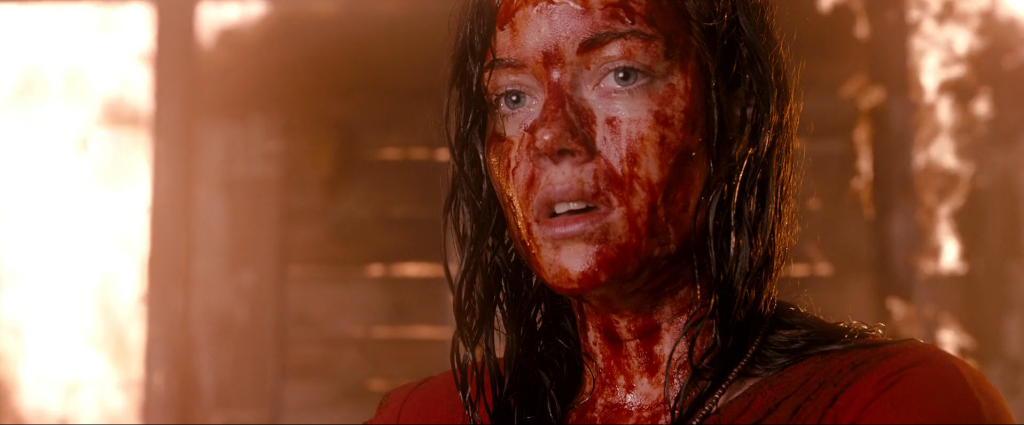
“When you think about Evil Dead, you have to know that you’re going to be introducing the Evil Dead universe to a new audience who have no idea what it is, so I thought you have to go back to the basics of what [the first] Evil Dead was.” – Fede Álvarez
Fede Álvarez’s Evil Dead (2013) turned 13 last month. Released 26 years after Evil Dead 2: Dead by Dawn, the fourth installment in the series wasn’t so much a return to form as a new incarnation. Famously (or infamously, depending on how you feel about the movie), Álvarez’s film unapologetically stripped all the splatstick and humor from the story, leaving only rivers of gore and a sludge of bone chips.
Naturally, this divided both fanbase and critics; the movie scored barely above average on review aggregation websites, though it earned $97 million against a meager $17 million budget, making it successful enough to fuel at least two sequels. The latest upcoming sequel, Evil Dead Burn, seems at first glance to be no more predisposed to humor than the previous two (Evil Dead Rise (2023) contained some more demonic giggling and a memorable sight gag of a hapless victim swallowing a flying eyeball, but not much more).
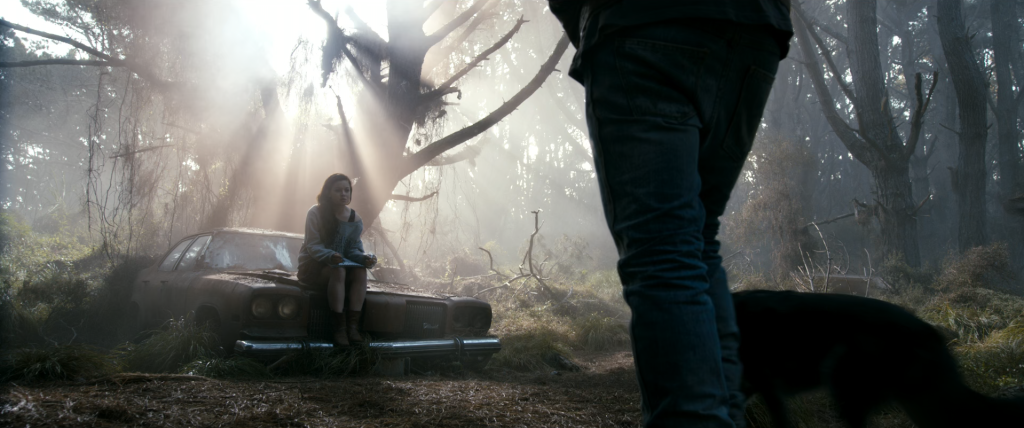
So what’s left if you remove the humor from the Evil Dead franchise? Is it still Evil Dead at its heart, or does it become just another demonic possession movie? What’s left if you take out all the laughs, demonic or otherwise?
Personally, I like both styles just fine, and I’m relieved neither Álvarez nor Lee Cronin (director of Rise) took a stab at Raimi’s very particular brand of humor. “That’s Sam Raimi. He’s a master of that,” Álvarez said in an interview. Further, Raimi was insistent that Álvarez put his own signature on it:
“Sam was really pushy with the fact that he wanted me to make my own film. Even with moments where I was trying to bring more elements in from the original film, he would be very insistent with that idea. He would be, like, “Fede, I want you to make your film. This has to be your film. You don’t want to rely on me for it to be enough.” He was really pushy in that respect.” – Fede Álvarez
By removing the need for subsequent filmmakers to ape his style, Raimi opened the door for them to bring their own flavor to the franchise. So what’s left over when you strip the humor from Evil Dead, or rather, what gets revealed? Among other things, a worldview that brings the cosmic horror elements of Evil Dead‘s world to the forefront.
Evil Dead differs from demonic possession films like The Exorcist (1973) and its innumerable imitators in that there is little to no spiritual force standing in opposition to the Deadites. There are no exorcisms in the Evil Dead universe, nor much in the way of Christian theology at all. No one holds up a cross to chant prayers in hopes of expelling a Deadite from the victim’s mortal shell. They are not deterred by Bible passages or the power of love or anything short of the mortal shell’s absolute destruction.
The mythology of the Deadites themselves is a mishmash of apocrypha from various films, shows, books, games, comics, and more, none of it quite lining up. This is as it should be: a legion of chaos demons who behave according to a strict set of rules is not just counterintuitive, it’s dull. What we do know is the Deadites are created by an entity called the Kandarian Demon, who sends corrupted undead souls from Hell into the mortal plane to torment the living. Little is known of Hell as it exists in the Evil Dead world, and the only mention of angels or Heaven comes from Marvel’s “Marvel Zombies vs. Army of Darkness“, which, look, I am not going to get into matters of “canon” here. Ash Williams also teams up with Vampirella and needless to say that doesn’t have much bearing on Mia and her pals from the 2013 film either.
The point is, if there are angels or a God in the Evil Dead universe, then they are silent. In this universe, not only is there no Heaven, but there is only a Hell.
Even in the prologue of Evil Dead (2013), where we see a sobbing young girl tied to a beam in a grubby basement and soaked with gasoline in preface to her immolation, there’s no priest intoning passages from the Bible in the hopes of saving her soul; rather, the occult volume Naturom Demonto (renamed from the Necronomicon Ex-Mortis and now without a tormented human face as the cover) is slammed open to a page that reads CHOP THE MOTHERFUCKER in a bloody scrawl. The basement is full of dead animals and signs of cinema folk magic.
When Mia (Jane Levy) enters the story not long after, her brother gives her a necklace made from buckthorn, commonly associated with protective magic. This necklace is broken about twenty minutes into the film, not long after Mia utters the only resounding appeal to the divine in the movie: “please, God, give me a break.” Whether or not He does in the end is a matter of interpretation.
The plot of Evil Dead opens with Mia, her brother David (Shiloh Fernandez), and her friends Olivia, Eric and Natalie traveling to the archetypal remote cabin in the woods so Mia can detox from her heroin addiction. If there were any temptation to make the movie About Trauma or pair Mia’s heroin addiction with demonic possession, the story artfully skirts around it: it’s a motivator, not an allegory. She does get confronted with hideous distorted reflections of herself during her withdrawal / possession, which might seem symbolic, but it’s also terrifyingly literal.
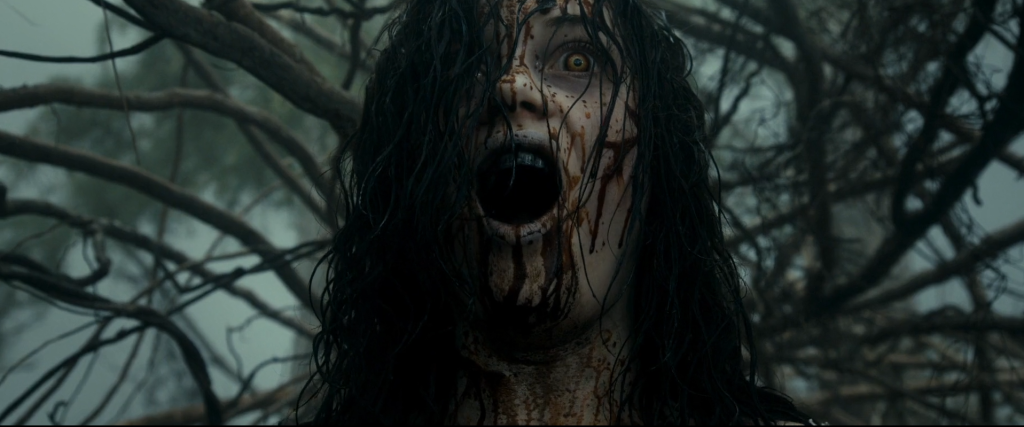
Mia’s addiction does offer us a few character points that feed into her role as the Final Girl, though. We learn that Mia has not only tried unsuccessfully to detox before, but that she legally died during her previous overdose. She’s been touched by death, and when the gang shows up at the wrecked hell-cabin to begin their weekend of terror, Mia is the only one who feels something is off. “There’s something dead here, and it reeks,” Mia says when they walk in, even before the creepy cellar full of dead animals and forbidden tomes is uncovered.
Mia is also the only one who overtly believes in the supernatural, and the only one who’s been through the hells of not only drug addiction, but helping care for her mother alone while her brother David went on living his life far away. In short, Mia has not only already been through hell, she’s still going through it, so it’s fitting that in the end she’s the one who survives it.
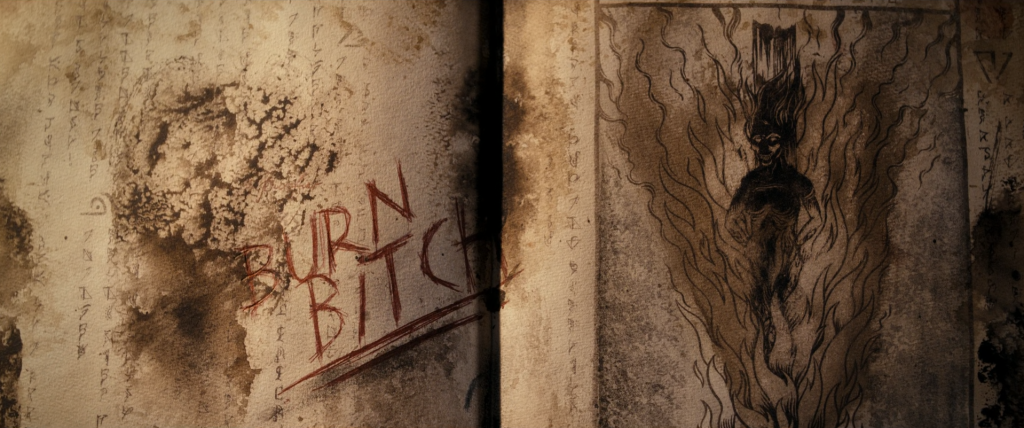
Hell has clearly already touched the cabin by the time the party arrives. Though Evil Dead (2013) barely acknowledges the franchise’s legacy of humor (although I maintain a dread occult tome that reads CHOP THE MOTHERFUCKER and BURN BITCH is pretty funny), it takes place in the same continuity, at least according to Fede Álvarez and Rob Tapert. There are tiny homages all over the place: Mia’s Michigan State sweater, David and Eric’s blue chambray and plaid wardrobe, and a select few one-liners. We’re given the tour of Chekhov’s various guns spread throughout the cabin: the nailgun, carving knife, sawed-off shotgun, and the Naturom Demonto itself, hidden away in the still-intact cellar full of dead animals.
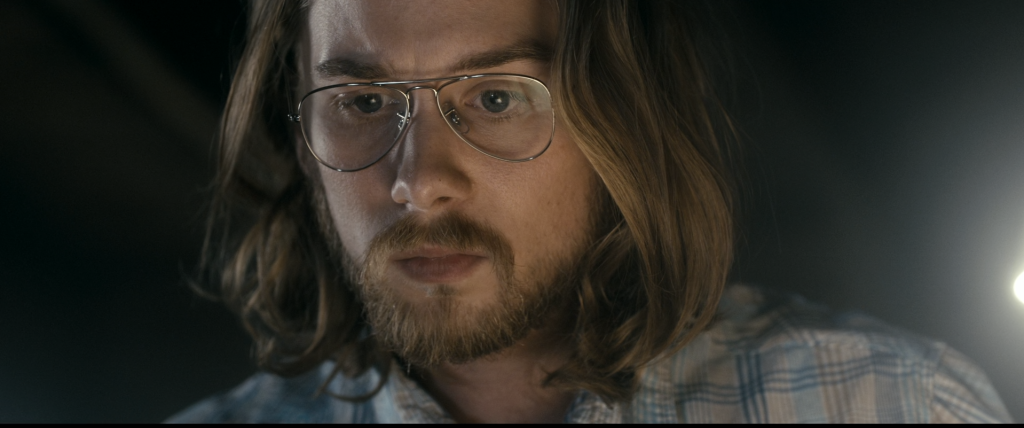
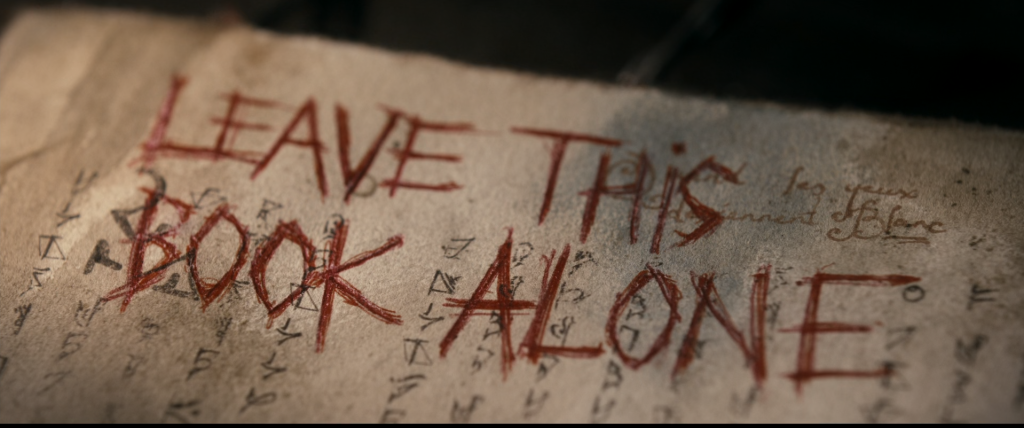
And then there’s Eric, the colossal dumbass who decides to spice up the big detox weekend by clipping the barbed wire off the Naturom Demonto and reading the passages aloud, thereby unlocking Raimi Monster-Cam Mode and setting everyone’s doom into motion. There’s no confusing Eric’s choices with accident. He blows right past the page that says LEAVE THIS BOOK ALONE and industriously does pencil rubbings of the scratched-out incantations just so he can read them aloud. Eric truly goes the extra mile as the Dude Who Definitely Doesn’t Know He’s in a Horror Movie.
Once the Deadite is unleashed, it’s all rapidly downhill. Mia returns from the woods possessed and looking brutalized. As she scalds herself in a boiling hot shower, her friend Olivia, faithful to the last, proclaims she “probably did it to herself.” Mia is rarely expected to succeed in this movie, and is constantly moralized against and treated as lesser. Her redemption comes not from trusting in a higher power, but by surviving what everyone else doesn’t.
Isolation sets in quickly. No one has any cell phones (a deliberate story decision by Álvarez, who wanted a “timeless quality” and a flash flood washes out the road. With everyone neatly cut off from the outside world, the carnage begins.
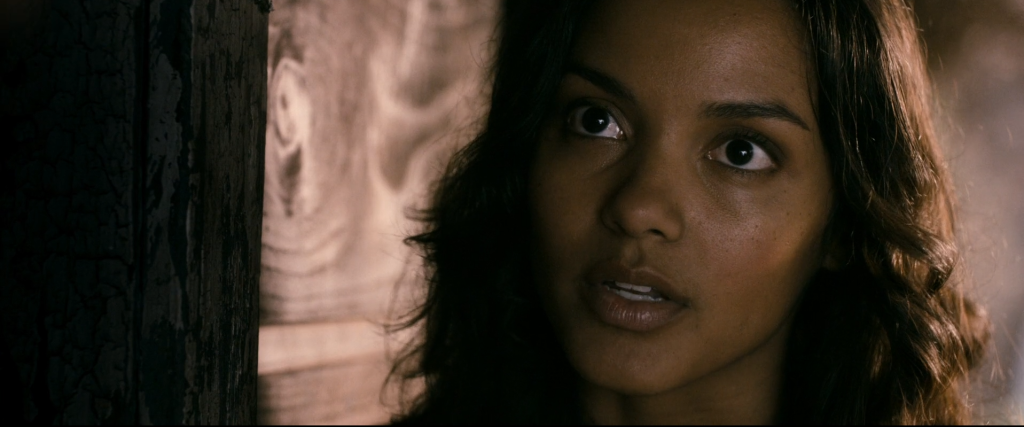
Loss of agency is a major theme of a lot of demonic possession media, and ties into the religious undertones of the phenomenon: if you don’t give yourself over to Jesus, then Satan will be waiting to attach the marionette strings and make you dance to his malefic tune. While Álvarez’s demons forego giggling and capering in favor of mutilating their hosts with grim and inventive determination, you could make the argument that while the human onlookers might not find the bloody self-mutilation of their friends humorous, the Deadites almost certainly do. The horrifying moment where the dismembered and dying Natalie, her face full of nails from a nailgun, whimpers “why are you hurting me?” to David just before she slumps over in death. Did the Deadite say this just to twist the knife in David one more time, or did it release Natalie at the last moment to die in agony and bewilderment? It’s one of the movie’s most effective moments, and either way, no doubt the Deadite found that funny as hell.
There’s no exorcism or release for victims of the Deadites; having them let you go is arguably the second-worst thing that will ever happen to you. The instructions for dealing with them in the Naturom Demonto are “live burial, dismemberment, or purification by fire,” all of which we see in garish detail by the end. There is no mention of a divine power to which one can appeal: the only relief is that of the grave, and the only solution to death and destruction is more of the same. There’s not a Bible nor rites of exorcism in sight, but Hell’s handbook is right there, indestructible and easy to use, trusting that humans will breezily ignore the copious warnings scrawled in blood. As we’ll see later in Evil Dead Rise, the Deadites are so easy to unleash that you can do it entirely by accident. If God exists, then He’s left few guardrails on the cosmos when it comes to summoning up the adversary.
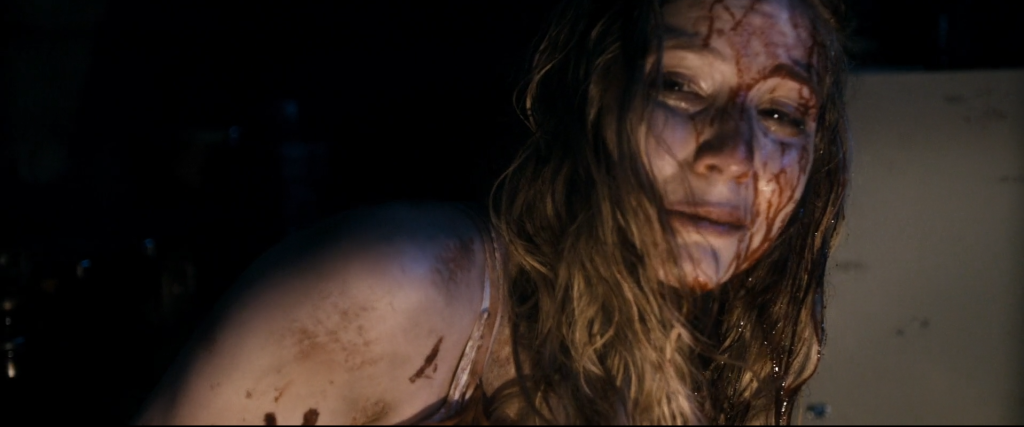
Álvarez’s film only has a passing flirtation with the mythos of the previous movies. There’s no mention of the Kandarian Demon by name, though we do learn about the Taker of Souls, who needs to collect five souls to unleash the Abomination, which we can only assume will be bad. The precise threat of the Abomination is unclear, but it barely matters: it’s mostly an excuse to have Mia fight a demonic image of herself with a chainsaw as a bloody rain drenches everything in red during the climactic battle.
In an inevitable homage to her predecessor Ash, Mia has to chainsaw off her hand to escape from being pinned under an overturned truck. She then sends the Abomination back to hell by splitting it down the middle in showers of gore while saying “feast on this, motherfucker!” Unlike previous installments, there’s no incantation or dread passage to read to close a portal or what have you; Mia just chainsaws the fucker in half and that’s that. The bloody rain stops, the mutilated Mia staggers out of frame, and we’re left with a shot of the indestructible Naturom Demonto and the promise of more victims to come.
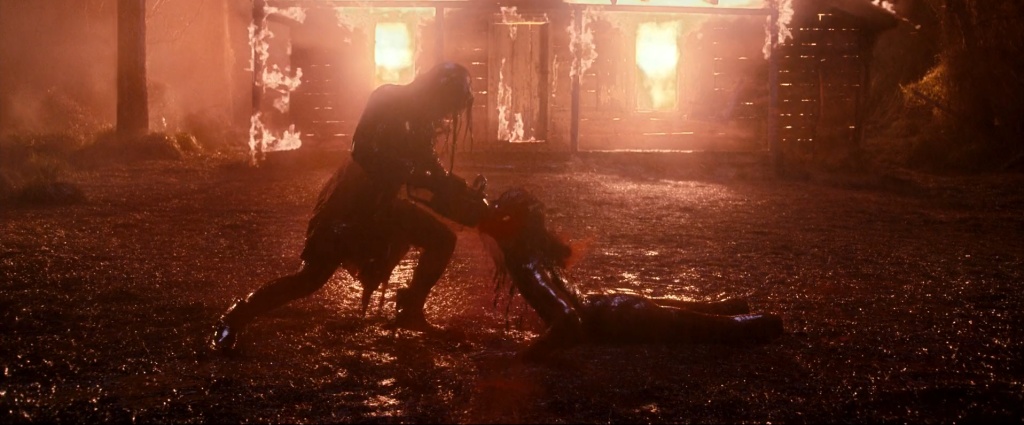
The Deadites of Evil Dead (2013) aren’t funny, nor is the film itself, but despite the underlying bleakness of the cosmos in which it resides, it’s not Serious Horror either. If Raimi’s original trilogy could be characterized as a horrific funhouse where clownish demons kill and mutilate for fun, then Álvarez’s films reflect a world where things are perhaps only funny to the demons, and even then they’re not laughing. The primary goal of both the Deadites and Álvarez are to foment chaos and disorder, in a world where there is no divine being or structure to which you can appeal, and even the demons only sometimes follow their own rules.
What it does show us is that redemption is self-made and ugly; not a neat process in which we say a few words and are forgiven or redeemed, but rather a bloody screaming mess which leaves us irrevocably changed. No one believes in Mia, least of all herself at the beginning, but she survives in no small part because she’s already been through hell and knows the only way out is through. Mia dies not once but twice before her story ends, and she survives what otherwise appears un-survivable: possession by a Deadite. In that sense, Evil Dead (2013) is perhaps the most optimistic film of the franchise yet seen, where the best-case scenario is that you’re down one hand but up a chainsaw and you finally got off heroin the extra-hard way.
Special thanks to Bobby Derie and Zak Jarvis for their help with this piece.
I’m woefully underemployed right now, so if you liked this article, it’d mean the world to me if you could throw me a couple bucks via ko-fi. And if not, no worries! Thanks for reading!