
For good or ill, we cannot blame Stephen King’s SLEEPWALKERS on cocaine.
As seductive and reasonable as it seems that the Mick Garris film, with screenplay by King — with its vampiric incest, death by corncob, shapeshifting cars, and assorted inspired lunacy — is borne of the same coke-fueled imagination that brought us MAXIMUM OVERDRIVE and THE TOMMYKNOCKERS, that’s not the case. By his own testimony, King’s wife Tabitha staged an intervention for him in 1987, and he cites 1991’s NEEDFUL THINGS as the first sober thing he’d written in decades. So, despite all evidence to the contrary, it appears King wrote SLEEPWALKERS while stone cold sober, which makes its mercurial insanity all the more breathtaking.
Some of that must also be laid at the feet of Mick Garris, whose work is hardly known for its subtlety and restraint, god bless him. Garris is arguably most well-known for helming Critters 2, which brought us the awe and wonder of the Critterball. He reportedly got the job directing SLEEPWALKERS for his work on PSYCHO IV: THE BEGINNING, a movie laden with terrible answers to questions nobody asked. Garris mixes horror and humor with equal aplomb, and nowhere more frantically than in SLEEPWALKERS, a movie that changes mood and direction about once every fifteen minutes.
Now, I am not about to shit on SLEEPWALKERS. That would be pretty hypocritical, given I’ve seen it easily half a dozen times. To me, asking whether it’s a “good” or “bad” movie is nigh meaningless. Good or bad at what? SLEEPWALKERS is its own rabid animal, caring little for your petty mortal notions of consistency or theme.
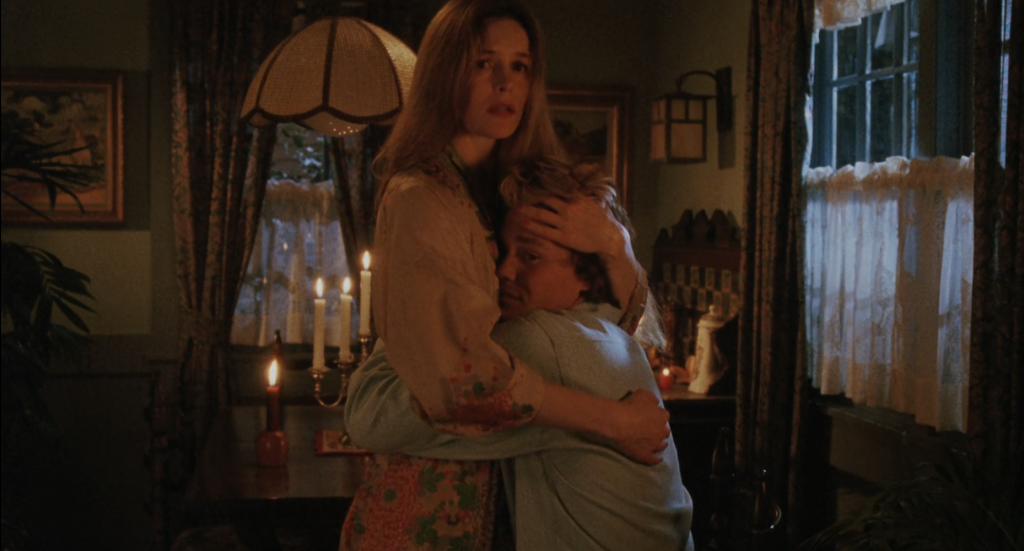
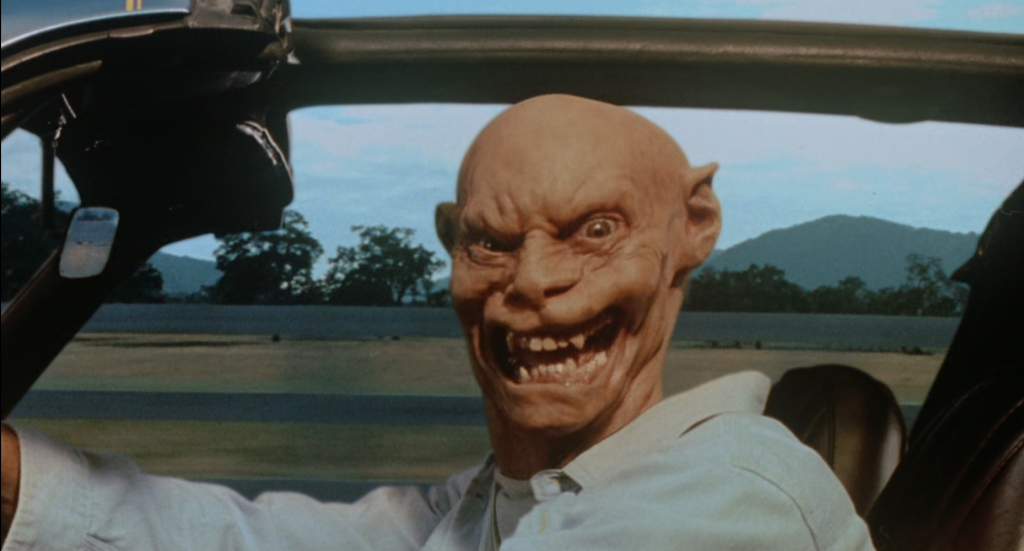
If you need a refresher (or, to your eternal shame, haven’t seen the movie yet), here’s the rundown: Tanya Robertson (Mädchen Amick), a popcorn girl at the local theater, becomes enamored with the cute new guy at her school, Charles Brady (Brian Krause). Unbeknownst to Tanya, Brady and his mother Mary (Alice Krige) are actually inhuman “sleepwalkers”, shapeshifting incestuous vampires who resemble demonic Canadian Sphynx cats in their true form (ironic considering cats are their sworn enemy and their only true weakness). The Bradys are the last of their kind, in hiding from humanity, and in dire need of a virgin’s life force to feed upon. Sweet, charming Tanya falls into the ravenous duo’s crosshairs, and we’re off to the races.
Though it’s got plenty of gore and a couple of decent jump-scares, SLEEPWALKERS is unlikely to be scary unless you’re a small child. It’s the kind of horror movie meant to be seen in the theater, while high, or in a theater full of people who are high. It’s a movie for laughing and hooting and hollering at throughout. It’s very good at being this sort of movie, and bad at being anything else.
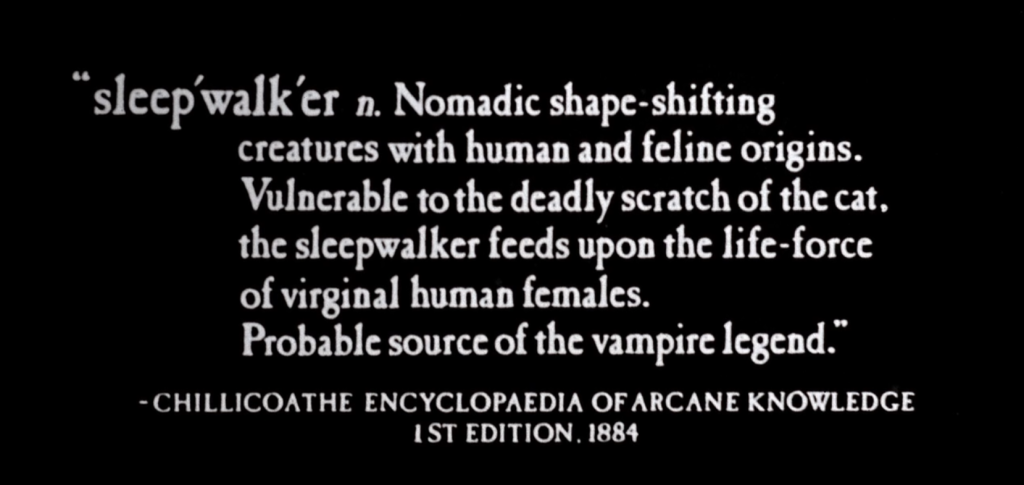
One of SLEEPWALKERS’ biggest charms is how its mood turns on a dime. It opens on a definition of its titular monsters, followed by a somber pan across ancient Egyptian hieroglyphs and musty books depicting Famous Cats of History to lend the sleepwalkers some credibility. The sweeping, ominous musical score lulls us into thinking we might be in for a NIGHTBREED-esque supernatural thriller in which the monsters are lent some tragic dignity, but we’re not. We’re not.
The front half of SLEEPWALKERS is surprisingly coherent and focused, given what comes later. Much in the tradition of THE EXORCIST, the first act or so of SLEEPWALKERS carefully builds up a sense of reality and equilibrium so it can violently tear it to pieces midway. Mostly the first act is watching the terminally beautiful Tanya smile and flirt with the sunny and effortlessly charismatic Charles, after a meet-cute at the theater where Tanya works.
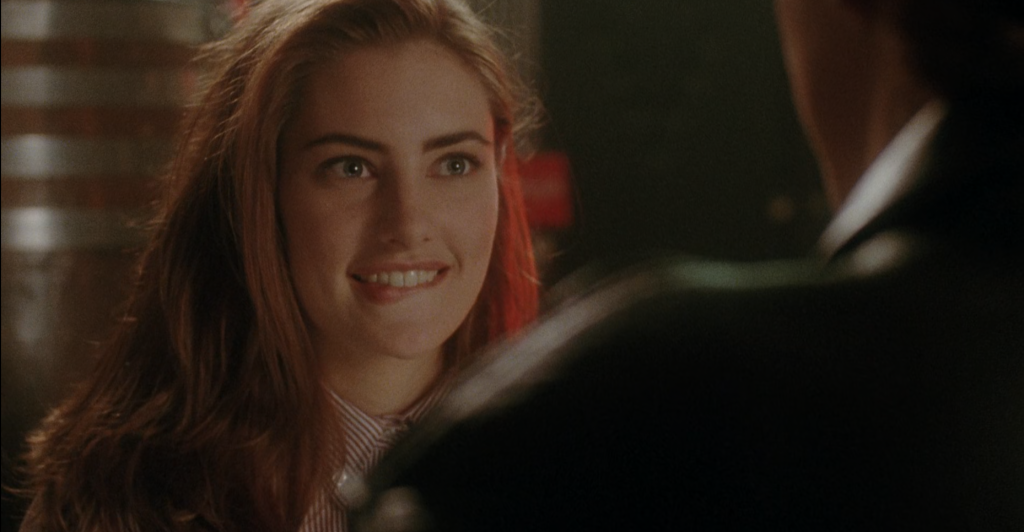
Charles bumps into Tanya as she’s bopping adorably along to The Countours’ “Do You Love Me (Now That I Can Dance)” on her Walkman, as teenagers were famously doing in 1992. I don’t actually fault the film for this; the music of the 50s and 60s is an integral part of early- to mid-career Stephen King and I’d miss it if it weren’t there in some capacity. Tanya and Charles hit it off instantly — after all, she thinks he’s cute, and he wants to drain her life essence so he can go on banging his mom — and they set up a first date to do gravestone rubbings at the local graveyard, again, like you do.
These initial scenes are on solid ground in terms of character and mood, which makes it all the funnier when that’s unceremoniously hurled out the window later on. Charles and his mother Mary have a hushed conversation lamenting their desperation and loneliness; Tanya smiles encouragingly at Charles in class when he recites a short story basically explaining what he is (way to stay hidden, Chuck). Later, as Mary and Charles plot to consume Tanya’s life force, Charles forlornly asks “does it have to be her?” All good stuff!
Then comes the first big seismic shift in tone. Mr. Fallows, a creepy sexual predator of a high school teacher (played by Glenn Shadix), gets overly handsy with Charles and loses said hand for his trouble. Fallows stumbles through the nearby marsh, cradling his bloody stump and shouting “I’m sorry!” as if he’d bumped into Charles in the hall. Charles runs him down, snacks on his torso, and then gets in a high-speed chase with Officer Simpson (Dan Martin) and the true hero of our story, Clovis the Attack Cat.
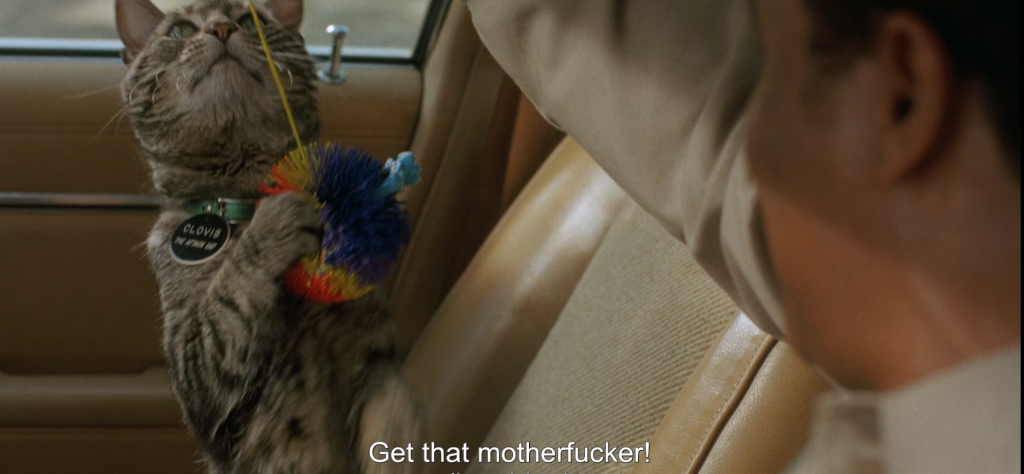
This part of the movie is a bit dumb but hardly off the rails; aside from some dodgy digital effects (it was 1992, it had a $15 million budget, there’s no sin to forgive), it’s nothing particularly dire. The movie doesn’t fully pack its bags for Crazytown until the ill-fated date at the graveyard.
Up to now, Charles has been nothing but sweet and charming with Tanya. He even manages to win over Tanya’s mom. Their graveyard date is flirty and playful, with snapping of photographs and a giggly, romantic roll in the leaves. If the movie hadn’t already showed its hand (haha get it) with Mr. Fallows earlier, what comes next might be a far more effective shock. They share a passionate kiss, and Charles’ hunger for virgin life-essence takes over.
Ignoring Tanya’s cries of “stop,” he turns into a beast and doesn’t take no for an answer, a metaphor that’s far from subtle. This could be a deeply upsetting moment, were it not for Amick and Krause appearing to be in two entirely different movies. Tanya’s sobs and whimpers are distressingly convincing, and watching her struggle underneath the feral and wisecracking Charles might even be traumatic to watch, if Charles weren’t trying to bury her alive under an avalanche of cheap one-liners. Even after losing an eye to a wine corkscrew (hell yeah), he can’t stop makin’ with the wisecracks!
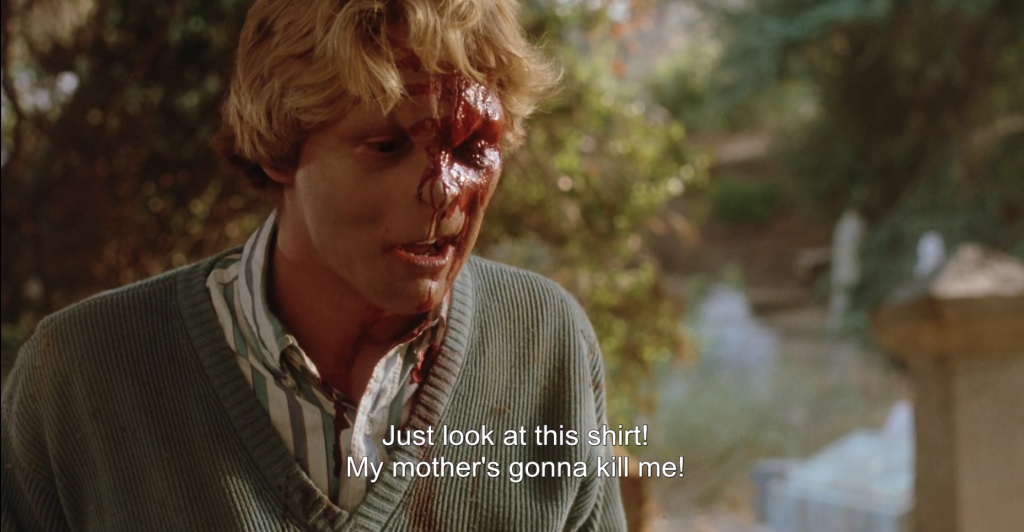
It’s at this point the performances start to fly off in all directions, like a chaos glyph in B-movie form. Tanya flees, running into poor Officer Dan, who soon suffers one of the movie’s two most memorable kills: a #2 pencil to the ear accompanied by a joyful cry of “cop kebab!” Amick gives her role everything she’s got here, screaming and begging like she’s in a real live horror movie, while Krause quips like he’s doing a tight five at the Date Rapists’ Club on open mic night.
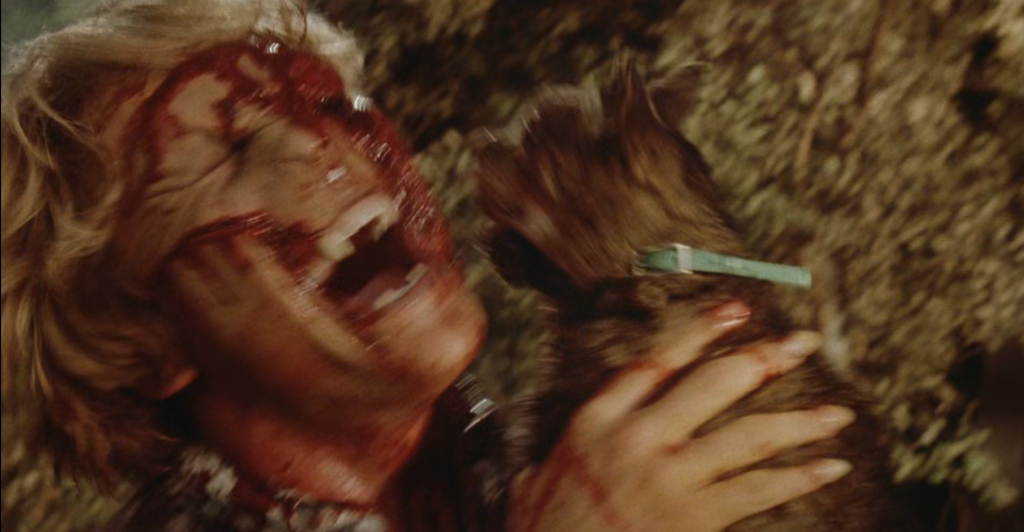
Charles’ glory is short-lived, though, as Clovis the cat promptly fucks his shit up by turning into a puppet and hurling himself at Charles’ face. This is not a complaint; one of the great joys of the cheapie horror movies of ages past is watching an actor hold a puppet to his face while thrashing and screaming “get it off me, get it off!” CG effects have largely taken this from us, and I think it’s a damn shame. Anyway, Charles staggers off, thwarted and gravely wounded.
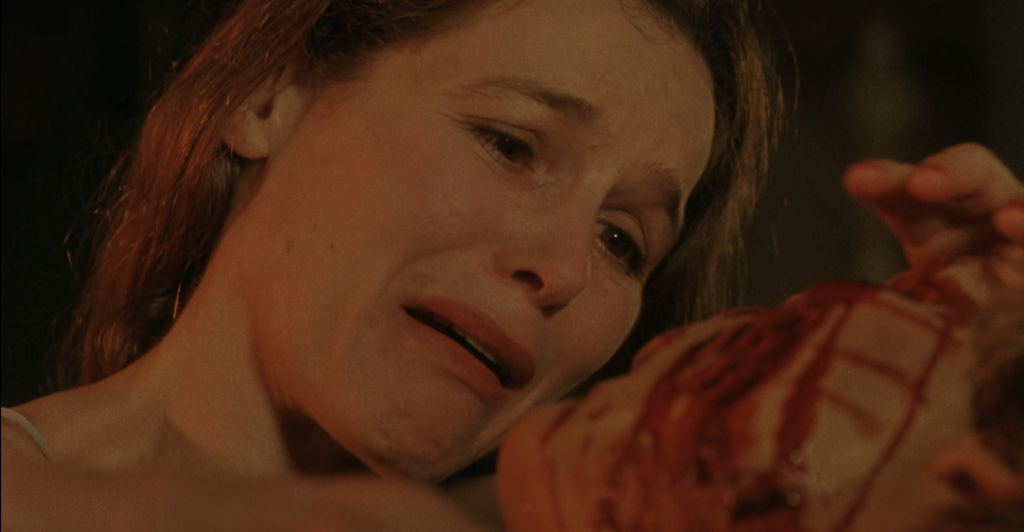
The tone dramatically shifts again as the dying Charles staggers home to mommy. Alice Krige, also giving her performance everything she’s got, shows genuine grief at her son’s mutilation. “I’ll take care of you,” she sobs, in a performance that’s genuinely moving despite the bloody slapstick of the previous scene. Mick Garris hired Krige based on her performance as the delicate, tragic Alma in John Irvin’s adaptation of Peter Straub’s Ghost Story, and she’s every bit as possessed of otherwordly beauty and menace here as she is there. This movie probably doesn’t deserve her, but I’m sure glad she’s in it.
The pendulum then swings back to goofy as we’re treated to a cameo of Stephen King as the beleagured cemetery groundskeeper, complaining at Clive Barker and noted real-life murderer John Landis about the damn kids with their graveyard rubbings and violent assault. (Tobe Hooper shows up later; if you like horror director cameos, SLEEPWALKERS is your shit.) But after a couple of dutiful yuks, we move on to a surprisingly sensitive scene of Tanya post-assault, sniffling as she asks if the police photographer has to take photos of her bruises and desperately trying to convince the cops to believe her story. Amick acts as if she’s in a serious movie and not one where a cat monster guy yelled “cop kebab” ten minutes earlier, and that’s borderline upsetting by itself.
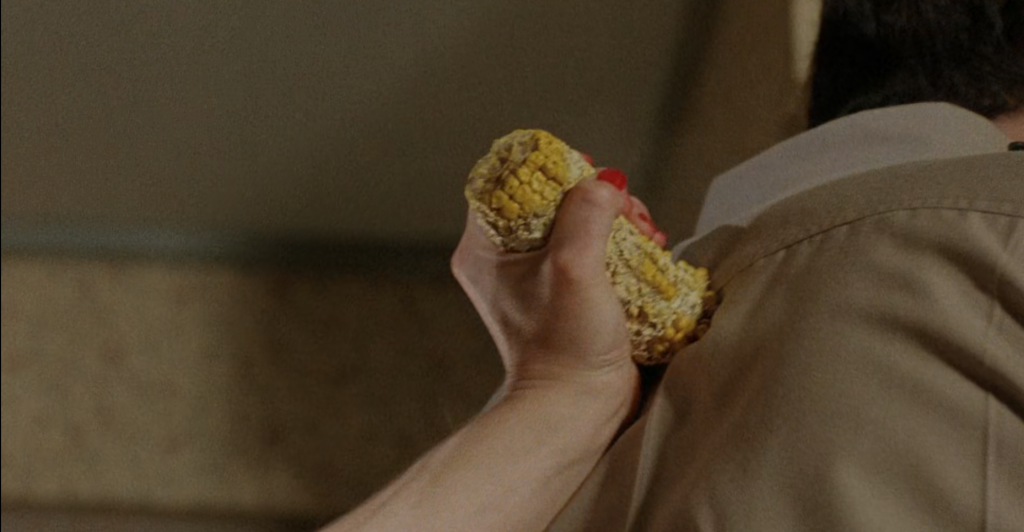
Anyway, the stage is set for the final confrontation. Ron Perlman shows up to make a couple quality jokes as dumbass cops mill around in the Brady’s yard, stepping on spring traps intended for the growing horde of lurking cats surrounding the house. Mary shows up to the Robertson household and promptly brains Dad with a lamp, possibly killing him, and then throws Moms through a window, possibly killing her. We can only presume so, since the movie completely memory-holes them the instant this happens. And it’s easy to understand why, as a moment later Mary kills a cop with an ear of corn in one of the most indelible horror kills since, I dunno, that guy getting decapitated by glass in The Omen? Then the whole house blows up, which almost certainly finishes off Mom and Pop if they weren’t dead already, and Mary abducts Tanya back to her place for a nice virginal life-essence dinner.
The final sequence in SLEEPWALKERS is played surprisingly straight. Mary drags Tanya in front of Charles, urging him to feed, but Charles is apparently dead. Mary rages in denial, using heretofore unseen telekinetic powers to animate his corpse to dance with Tanya to the tune of Santo and Johnny’s eponymous track. It’s a macabre scene that works surprisingly well, mostly to the credit of Amick’s performance. Charles is coaxed back to life, or maybe he was never dead and just hibernating, or something, I don’t know and I’m not sure the movie does either. The sheriff and Clovis show up, the yard cats lay siege en masse, and Mary burns to death lamenting the death of her son. “It’s just you and me now, Clovis,” Tanya says as she cradles him, and the movie fades out as the legion of vengeful cats wander off, having finally driven their ancient enemy to extinction (at least until Sleepwalkers 2 gets made).
Modern horror cinema is full of movies that know exactly what they are. Maybe they’re slashers out to disgust you with oceans of blood and flying bone chips in 4K. Maybe they’re About Trauma, with poltergeists that are actually Alzheimer’s metaphors and haunted houses that are sublimated anxiety over the cost of home renovation. Obviously, there’s nothing wrong with a movie setting out to be a certain way and forging a clear path there, but there’s also a ton of charm in the undisciplined chaos of something like SLEEPWALKERS. One moment, Alice Krige is giving a genuinely moving performance of material grief; the next, a hand puppet is clawing a guy’s face off. A cop is murdered with a corncob. The heroine is forced to dance with a corpse. Mark Hamill shows up. You cannot get ahead of this movie. Anything could happen and frequently does. In an age where too many horror movies are focus-grouped, watered down, and made as broadly palatable as possible, there’s something wild and precious about a movie like SLEEPWALKERS.
Thanks for reading! Your support helps keep this project going, so If you enjoyed this and want to support my work, you can throw me a couple bucks at buymeacoffee or ko-fi. As an Amazon affiliate, I also receive a small commission on purchases made from qualified links. Your support means everything!